What: Pine Creek 100 Mile
When: September 12-13, 2026
Start/Finish: 1551 Marsh Creek Road, Wellsboro, PA
Time: 23:38:31
Previous Finish? Nope, first Pine Creek 100-mile
Disclaimar
If you’re thinking about running this race, go ahead and sign up. It’s a fun event with great volunteers and an extremely scenic course. The logistics are simple, which makes it great for first-timers as well as those looking to set 100-mile PRs.
But be warned: flat doesn’t translate to “walk in the park.” Eventually, you’ll begin to crave a hill like a person lost in the desert craves water.
Or maybe not.
(What happens on the trail stays on the trail . . . .)
Anyways, back to the . . .
Background
. . . beginning.
I signed up for the Pine Creek 100 after DNF’ing MMT 100 in May. This, of course, doesn’t make much sense until you know that I was originally signed up for Eastern States in August.
Yeah, Eastern freakin’ States.
Well, it didn’t seem like the best idea to attempt to break my 100-mile DNF “streak” (0-3 in my last 3 attempts; 8-2 before then) at a race as brutal, unforgiving, unrelenting, and soul-crushing as the Eastern States 100. (See, even I can make good decisions sometimes.) So a friend of mine suggested signing up for the Pine Creek 100 instead (which he had also signed up for), and after some thought (fine, about five minutes of mulling it over), I did.
One thing you’ll notice immediately when signing up for Pine Creek is the price. At a time when most races, even smaller, local events, are charging $300-400 bucks a pop, Pine Creek 100-mile bucks the trend and comes in at $200.
$200?
Yes.
For a 100-mile race?
Yes!
What year is it, 2019?
No, it’s not 2019, unfortunately, haha. But in 2026, when everything is, well, more expensive (diplomatic speak, ladies and gents), finding a 100-mile event at or under $200 is like finding the proverbial needle in a haystack.
Anyway, after signing up, I took a somewhat conservative approach in my training. I know, I know–me? Ha! I guess it’s all a matter of perspective. Some people would view what I did as a lot, while others would view it as the bare minimum. The nice thing about endurance sports is that I can do me, and you can do you. I don’t run to chase PRs, podiums, or sponsorships. If the average “ultra career” even for a casual like me is 5 years (which I’ve heard is about average), then I’m already well over the hump. This is as much a lifestyle for me as it is anything else. I’ve done the 50-mile ‘tune-up’ training efforts, back-to-back long runs, and hours-long hill repeat sessions before, and while they were beneficial at the time, I found them to be detrimental to my long-term enjoyment. The same goes for speedwork. I don’t do speedwork (except for the occasional ‘pick me up’ during a run) because I don’t want to. I don’t need to do it to finish the events I want to finish, so why bother? Life is too short to do things you don’t want to do for the sake of chasing minutes in a race where hours can be lost from things entirely outside of your control. If you find the idea of training for a 100-mile race without doing speedwork, back-to-back long runs, or a ‘big effort’ tune-up race to be crazy, then more power to you. You do you.
(Okay, I’m going to step off the soapbox now.)
I’ll save the training talk for a future post, but in general, I like to remain in “ultra shape” all year long. This has made jumping from event to event easier because I don’t have to start from ‘nothing’ to arrive at ‘something,’ as I’m at the ‘baseline’ basically all the time. This isn’t something you can achieve overnight, of course; it takes years of consistent miles to reach this point. But when you do, it makes all the difference in the world.
I did complete two fat-ass races before taking on The Ring/Pine Creek double–Catherine’s FA 50K in July and Martha Moats Baker 50K in August. These two “training efforts” were geared more towards the Ring rather than Pine Creek, but I balanced these two mountain 50Ks out with nine 20-mile efforts throughout the end of May, June, July, and the beginning of August. I kept the long runs mostly easy, sticking to routes with a mix of trail/road and minimal elevation gain. The one exception to this schedule was a 21-mile run I did on a nearby bike path in August, where I ran the entire route on asphalt.
Okay, deep breath. Some final housekeeping before getting to the actual race:
I would estimate my total miles between the final week of May through the first weekend of August, when I ran Martha Moats, my final training run of the block, to be north of 700. Or thereabouts.
I can’t overstate how difficult “running” flat for 100 miles is on the body. Conditioning yourself to handle the repetitive motions that come with such a course is paramount. This remains true even if you’re walking a lot, because the same stresses will be applied to the body, though obviously with less impact. Your body will hurt in ways you never knew it would or could.
These events are supposed to be fun!! So remember to smile even when the going gets tough. You signed up for this, after all!! (Or maybe you just like reading about them; either way, you only have yourself to blame.)
Anyway, let’s get to it.
Before the Start
I drove down to Wellsboro the day before the race. The drive itself wasn’t too bad–north of 5 hours with two stops–and I arrived just after 1500 at the Ole’ Covered Wagon Tours campground.
Now, let me say this: if you plan to run Pine Creek 100, I wholly recommend staying at the Ole’ CWT campground. The campground was within sight of the start/finish line (I was able to walk from my campsite to the start/finish on race morning without issue), and at $25 a night it doesn’t get much more affordable than that. Yes, it’s dry camping (car, tent, or trailer accessible; no water hookups), but as someone who has dirtbagged it before in much worse spots, I found it to be one of the better experiences. They also have multiple (clean) portable toilets within 50 yards of whichever of the campsites you end up staying at, as well as an extremely hospitable staff (in addition to Sky, the business’s resident K9). Overall, A++.
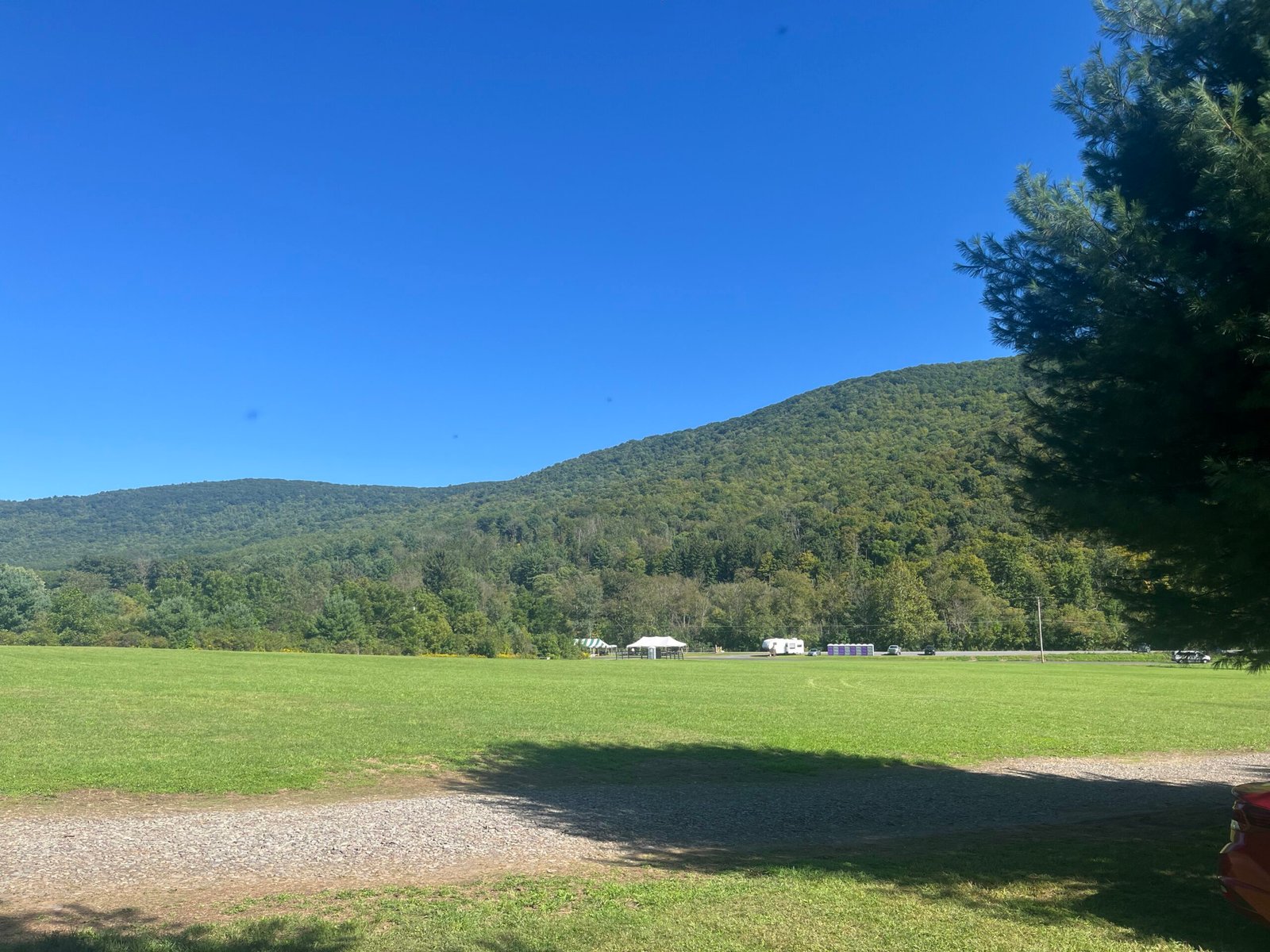 See that? Yeah, that’s the start/finish line!!
 One of the trees beside the campsite.
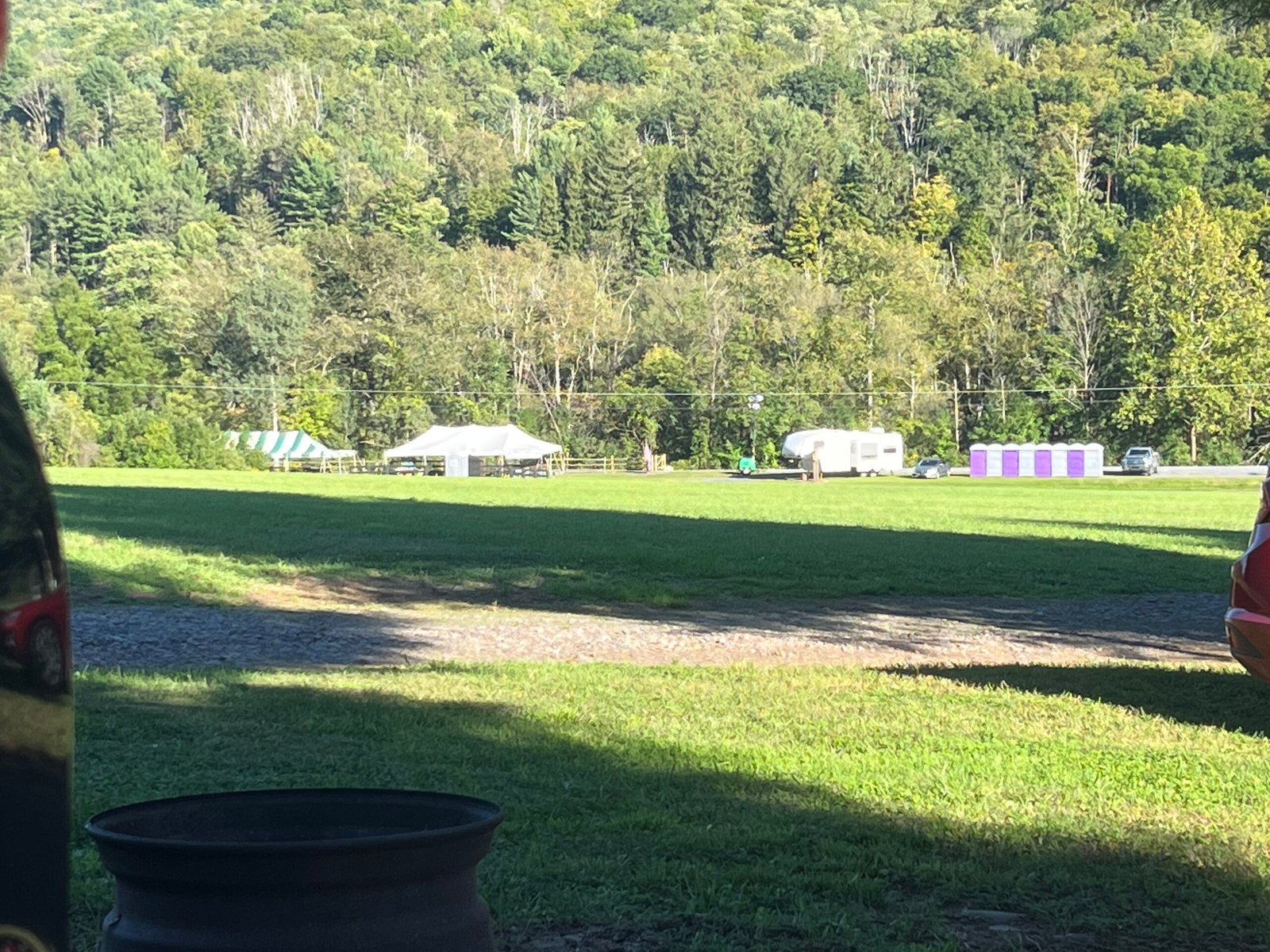 Okay, see? It doesn’t get much better than this, imo.
I decided to sleep in the car, as I’ve done in the past. This isn’t because I have something against tents (a tent is going to be the more comfortable way to spend the night), but I just didn’t want to deal with the teardown after the race was over. The exception would be for a summer race, where sleeping in your car might result in you sweating to death, lol. But for a September race in PA, I didn’t end up having any problems.
After getting everything set up/sorted, I kicked back and enjoyed some pre-race pizza and a Diet Coke (yeah, yeah–sue me) until I got interrupted (in a good way) by the arrival of my ultra friend, Casey, who, along with his family, drove by the campsite to say hello before heading to their cabin about 2 miles down the road. It was good to see him again, even though I knew I’d be seeing him a lot more the next day. I also spoke with Louis, who was staying at ‘campsite two’ next to me, and found out he was going to be taking on the 100k. We talked strategies for long events, and I was impressed to learn he would be walking the entire 100k distance. Sounds simple, but we all know it’s anything but simple!!
I capped the evening off with about an hour of reading before heading to bed at 1900, and was asleep by 1930 or so.
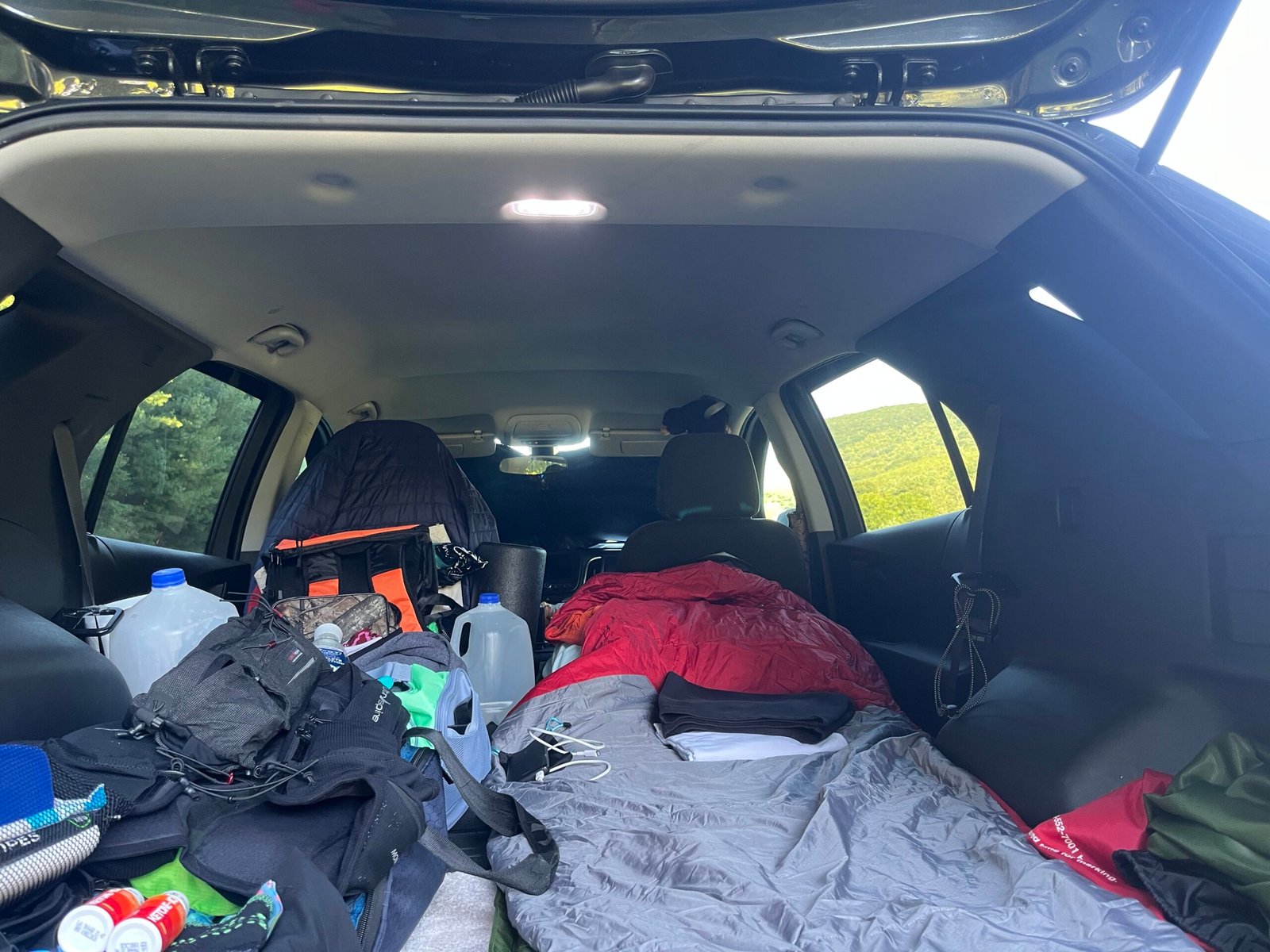 Make sure you fit in your car before trying to sleep in it. Ask me how I know.
Race Morning
I slept a solid 7ish hours with minimal interruption before rolling out of bed at 0345. This is a fairly standard wake-up time for me, so I didn’t have any problems getting right to the things that needed to be done. I won’t bore you with all the details, except to say that planning out everything you need to do the night before a big race/event/effort is paramount, so you don’t overlook something important during the morning rush. I left for the start line just after 0500 (the 100-mile race starts at 0600) and was one of the first racers to arrive.
I elected not to go to the pre-race “swag pickup” the day before because you couldn’t actually pick up your bib until the morning of the race. I ended up with number eight (thank the ‘B’ lastname), which I then added to my two drop bags. Speaking of,
DROPBAGS!!
Sorry, I didn’t mean to yell at you, but don’t you love drop bags?
Yeah, I don’t either.
Maybe it’s because I’m such a low-maintenance runner, but I’ve always struggled with what I should/shouldn’t put into drop bags. Nutrition? sure. Lights? Yes, where applicable. Extra shoes? There’s nothing like a late race shoe change!! Recovery . . . tools? Er, maybe? 100-piece med kit? Well . . . . Extra batteries for your drone? I mean– Toe Knife? Toe Knife??
You get the idea. I tend to underpack rather than overpack, though sometimes part of that comes from hubris rather than sound, rational decision-making. “I won’t ever need that” until I do. If you find yourself on the fence about something, then it’s probably a good idea to throw it in, just in case. “I would rather have and not need than need and not have,” or so it goes.
After depositing my two drop bags–the Blackwell bag, which I would see at miles 32.8 and 83.2, and the Marsh Creek bag, which would remain at the start/finish line–I made a trip to the bathroom before beginning the dreaded pre-race mill about. (Yes, one of the drawbacks to showing up early is that you often find yourself waiting around for things to happen, but I would rather be an hour early than a minute late, so it’s a circumstance I’m used to dealing with.)
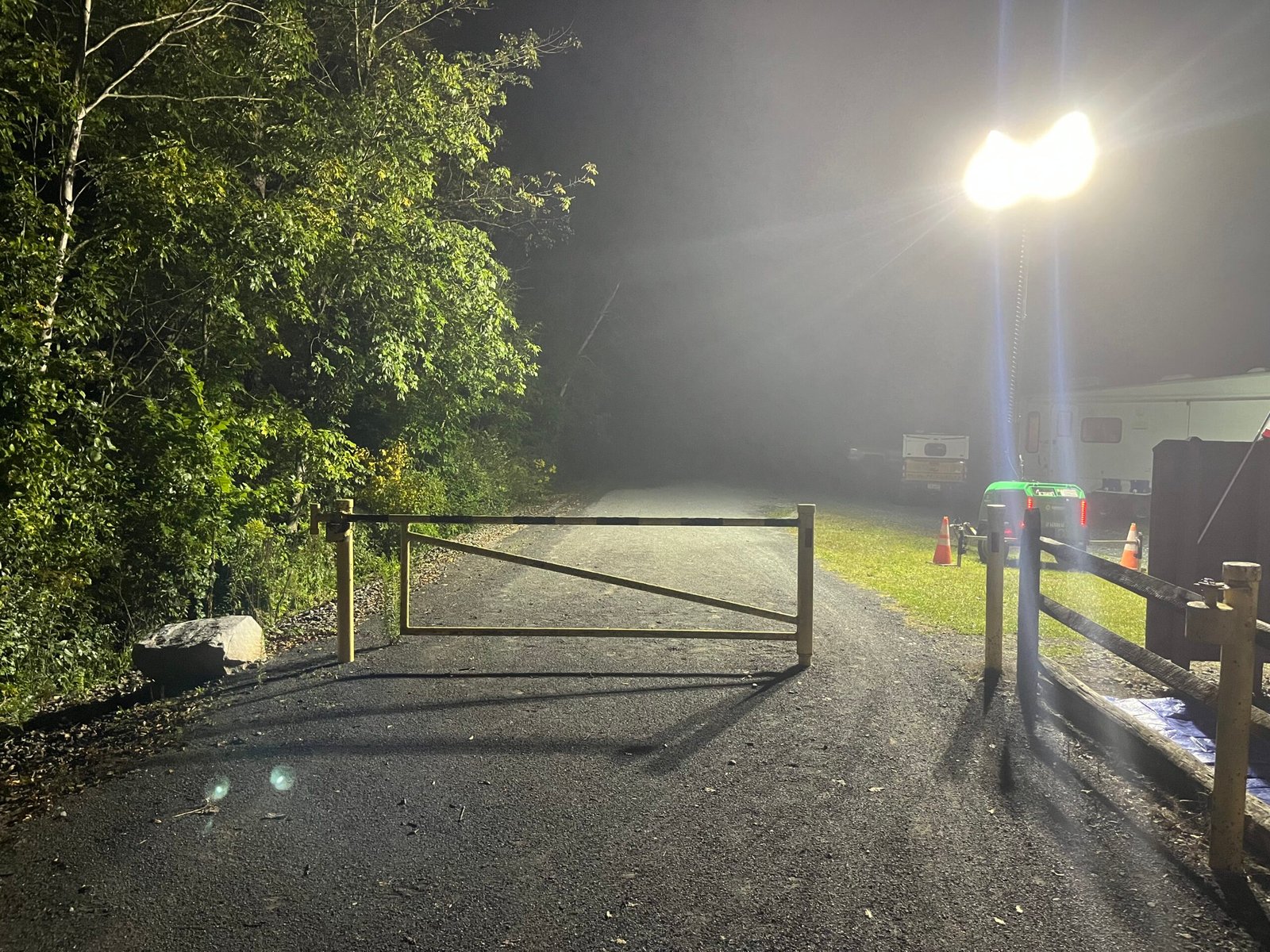 No, this isn’t the Barkley Gate, but it is a Pine Creek Trail Yellow Gate.
During the pre-race wait, I linked up with Casey and Grayson, both of whom I would end up spending quite a bit of time with over the course of the event. We talked a bit, but it was mostly a waiting game as the hour of the start drew nearer. I don’t think I was nervous, so much as I was anxious to get started. The waiting is the worst part; at this point, all you can do is execute.
I suppose I should elucidate on my mindset heading into this race. I had a single goal: to finish. Yes, that’s what everybody says (what was your real goal?), but in this case, it was my real goal. I hadn’t finished a 100-mile effort since CAT 100 in December 2024, and with three consecutive DNFs to my name, I didn’t want Pine Creek 100 to become the fourth. In truth, I needed to finish this race. I feel like a lot of future planning was riding on this. Was I done with the distance? The thought had crossed my mind more than once in 2025/2026. Could I still do it? Had I lost whatever “it” was that got me to the finish line at eight other times? Mentally, I’ve been so out of it lately that I felt like another DNF might’ve been the final signal to pack it up. I would keep running, but my days of running 100s would be over.
Yes, dramatic, I know.
But that’s how I was thinking. All my recent DNFs could be attributed in large part to mental failings. I quit upstairs before the downstairs part could catch up. It’s hard enough to fail at something, but it’s even tougher when your “failure” is self-imposed. I didn’t have to stop, but I did. What kind of ultrarunner did that make me?
A normal one, no doubt. I’m sure most people who run these long events go through this sort of “mental funk” at one point or another. It’s part of the game, but so is getting out of it. And Pine Creek 100 would be the race where I finally got out of the red and back into the black.
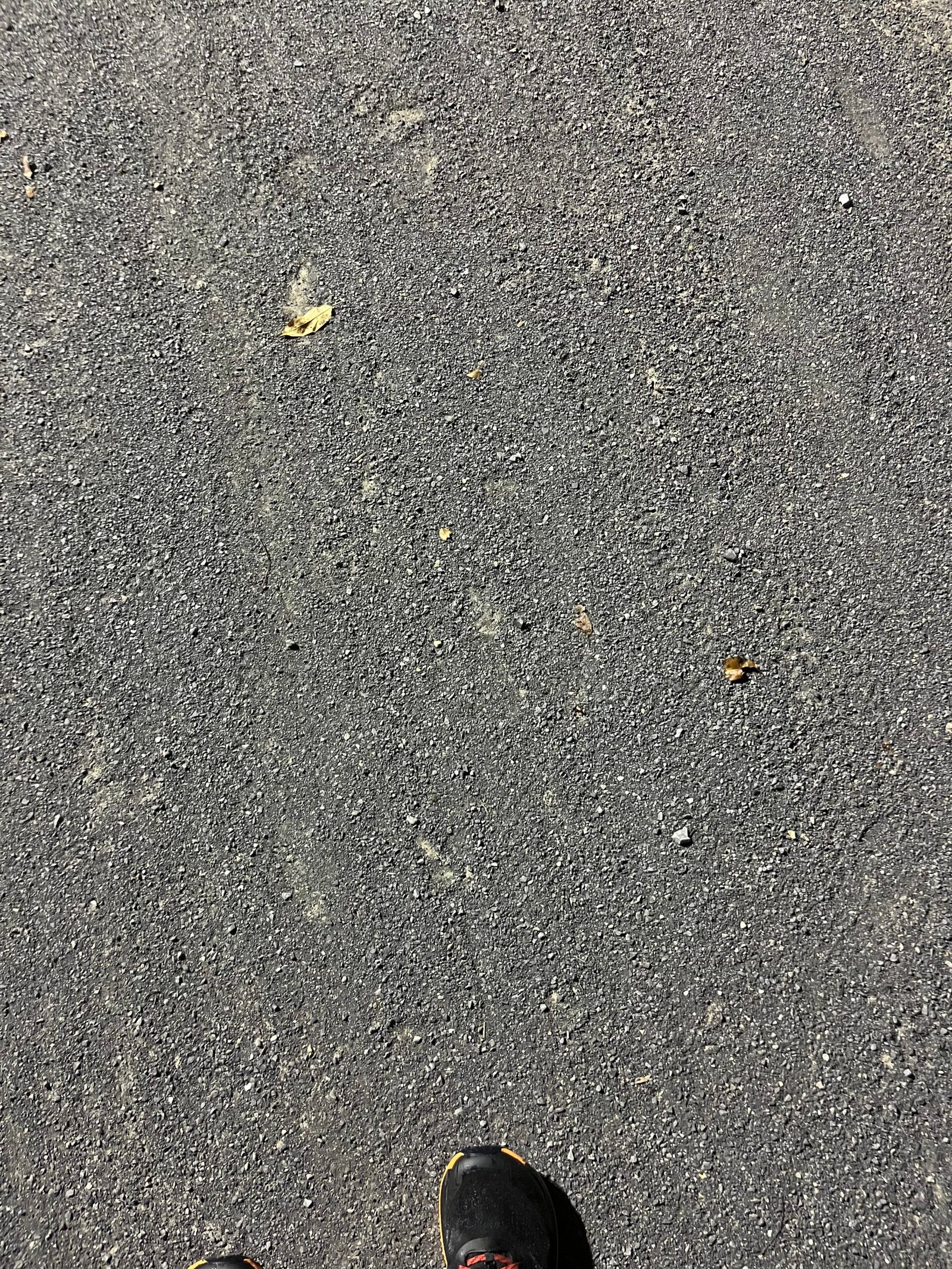 Pine Creek trail surface. I would recommend gaiters.
The start to Wellsboro Junction and back (0 to 15.2 miles)
The gun went off at 0600, and we took off . . . like sloths from a retirement home.
Okay, we weren’t that slow. The pace was somewhere around 10 minutes per mile, but it felt effortless in the cool morning on such a flat surface. The trail was covered in fog, which endowed it with an ominous air.
I immediately settled into running with Casey and Grayson. Casey is an old ultra friend, whom I’ve spent a lot of time and miles with over the years. He’s a 100-mile veteran with around (or over) twenty 100-mile finishes under his belt, including some tough stuff, like Western States and CAT 100. Grayson, a friend and training partner of Casey, is the complete opposite: an ultra newbie with a single 50K finish to his name. Would it be enough?
We–and by “we,” I mean Casey–had decided to follow a 9:3 run/walk schedule from the start of the race. On a flat course, one of the biggest mistakes you can make is running too much at the start. “Jogging” at a 9-10 minute pace for 40-50 miles is all well and good until you have to take on the second half of the event. Flat kills your legs slowly, without you realizing it, and by the time you do, it’s too late. So having a plan early is paramount to maintaining an effective flow from start to finish. (Now, if you’re going for a sub-16, 15, or 14-hour time, then by all means do your thing, but for us mere mortals, adding in walking from the start could be the difference between finishing or ending up in the DNF chair.)
The sun didn’t come up until maybe 30-40 minutes into the run, but even then I never felt like I needed a bright light. The trail is smooth, and except for a single detour to bypass a bridge under reconstruction, free of tripping hazards and obstacles. The course isn’t marked, but it’s impossible to get lost (though after finishing, I did talk to another runner who managed to fall asleep while walking and ended up going in the wrong direction for a bit before correcting the mistake).
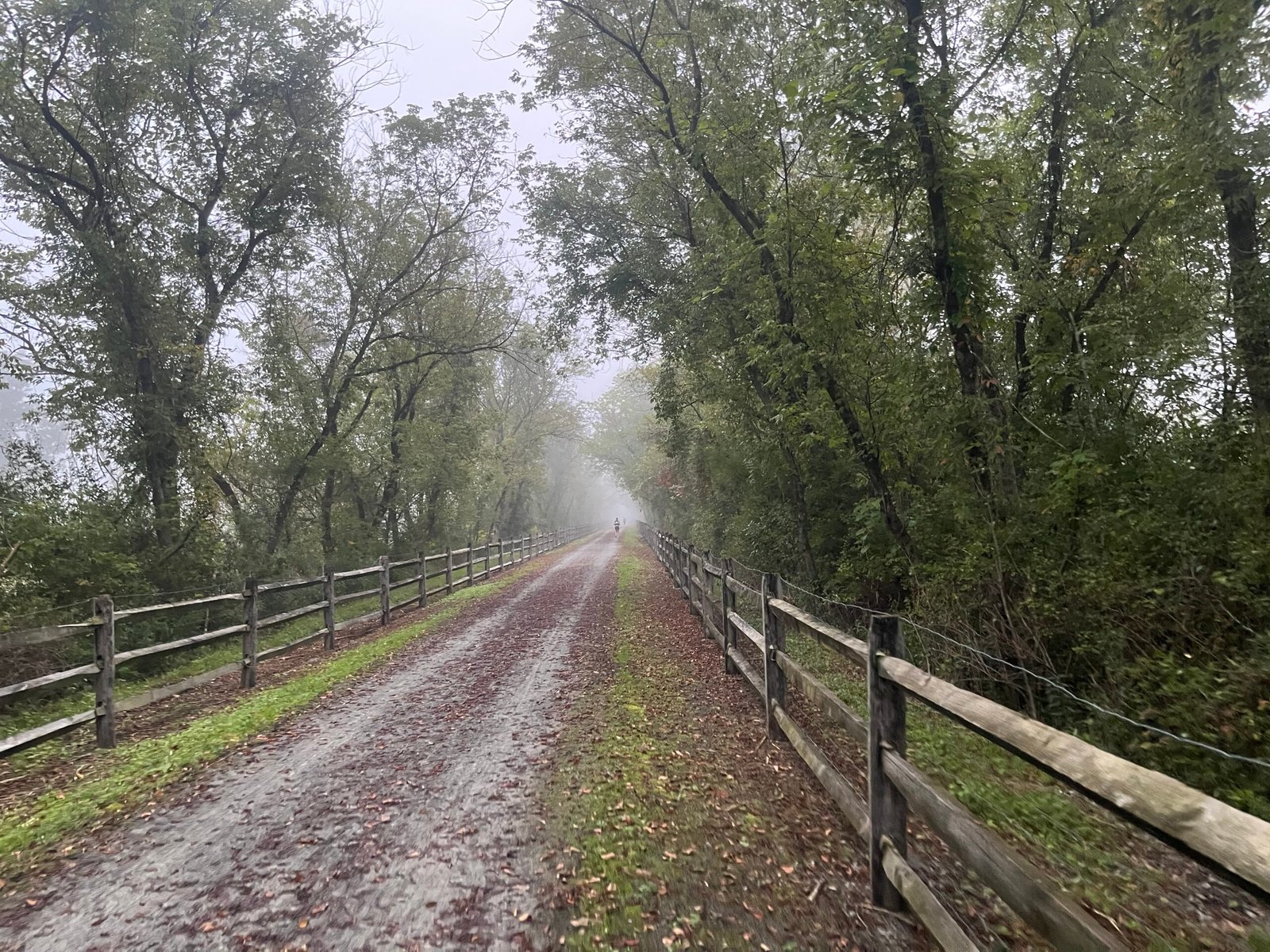 When the sun did come up, we were greeted with some Left 4 Dead-style landscapes.
The early miles were relatively uneventful. Everything feels effortless when you’re an hour into something. The goal for this first 15-mile section was to settle into the groove of things, learn the course the best I could, start on my nutrition, and practice not thinking too far ahead. This is always made easier when you’re surrounded by good people, and the vibes early were great, both from our little Triumvirate, as well as the other participants. I saw some fellow VHRTC members out on the course, and the out-and-back nature of the section made the camaraderie among the runners a breeze to maintain.
We didn’t stop at the first aid station at Cavenaugh, mile 3.6, because it wasn’t set up…at least I don’t think it was? I wouldn’t have stopped even if it was, because I didn’t need anything. Our first real aid stop didn’t come until mile 7.6 at Wellsboro Junction, the first of two trips we would make to this aid station, as well as the first turnaround of the race.
(In case it wasn’t clear: The 100-mile race consists of two 50-mile “loops,” with each “loop” having two out-and-backs. The first out-and-back runs from Marsh Creek (mile 0, 15.2) to Cavenaugh (mile 3.6, 11.6) to Wellsboro Junction (mile 7.6) and back (15.2 miles round trip). The second out-and-back runs from Marsh Creek (mile 15.2, 50.4) to Darling Run (mile 16.6, 49) to Tiaghdaton (mile 24.4, 41.2) to Blackwell (mile 32.8) and back (35.2 miles round trip). This is then repeated to get the full 100-miles.)
I wanted to keep my aid station stops as minimal as possible. A mistake most people make is spending way too much time inside aid stations. Now, the volunteers and aid stations themselves were all great, but I prefer to treat aid stations like F1 stops and not a stroll through the aisles of a grocery store. Part of becoming efficient inside aid stations comes from experience, but it also stems from having a plan formulated before you even arrive. These “plans” aren’t something you develop before a race–though with big-picture things like changing shoes, wardrobe adjustments, and so forth, you should have a general idea of when you would like to do those before the race–but instead come about as a natural result of you running the race. For example, going into Wellsboro Junction, I knew I needed to fill my bottles (step one), grab something to eat (step two), and maybe take something for the road (step three). Once this checklist was completed, I was out of the aid station. I didn’t sit down, chit-chat, and then start to think about what I needed/wanted to do. This all may seem trivial, but, for example, at Pine Creek, if you spend 5 minutes extra in each aid station, then you’re looking at nearly 1 hour of wasted time. What if you miss a cutoff because of such inefficiencies? The goal should be to maximize your moving time on course while minimizing your stopping time on course.
After leaving Wellsboro Junction, we began our return trip to Marsh Creek. Again, everything felt good for the most part. I was, of course, worried about how my body would handle the flat miles only a week after finishing The Ring, but other than some minor right knee pain at the start, which quickly worked itself out and never reappeared, nothing screamed at me more than usual. I tried not to think too much about aches and pains, though, as I knew plenty of those would develop throughout the event.
The fog gradually lifted as the sun came completely out, and I was finally able to get a solid grasp of the landscape we were running through (it’s hard to know where you’re at when everything is obscured). Of the two sections, the first, Marsh Creek to Wellsboro Junction, was the more familiar of the two to me as someone who spends a lot of time running the roads and trails in the DMV.
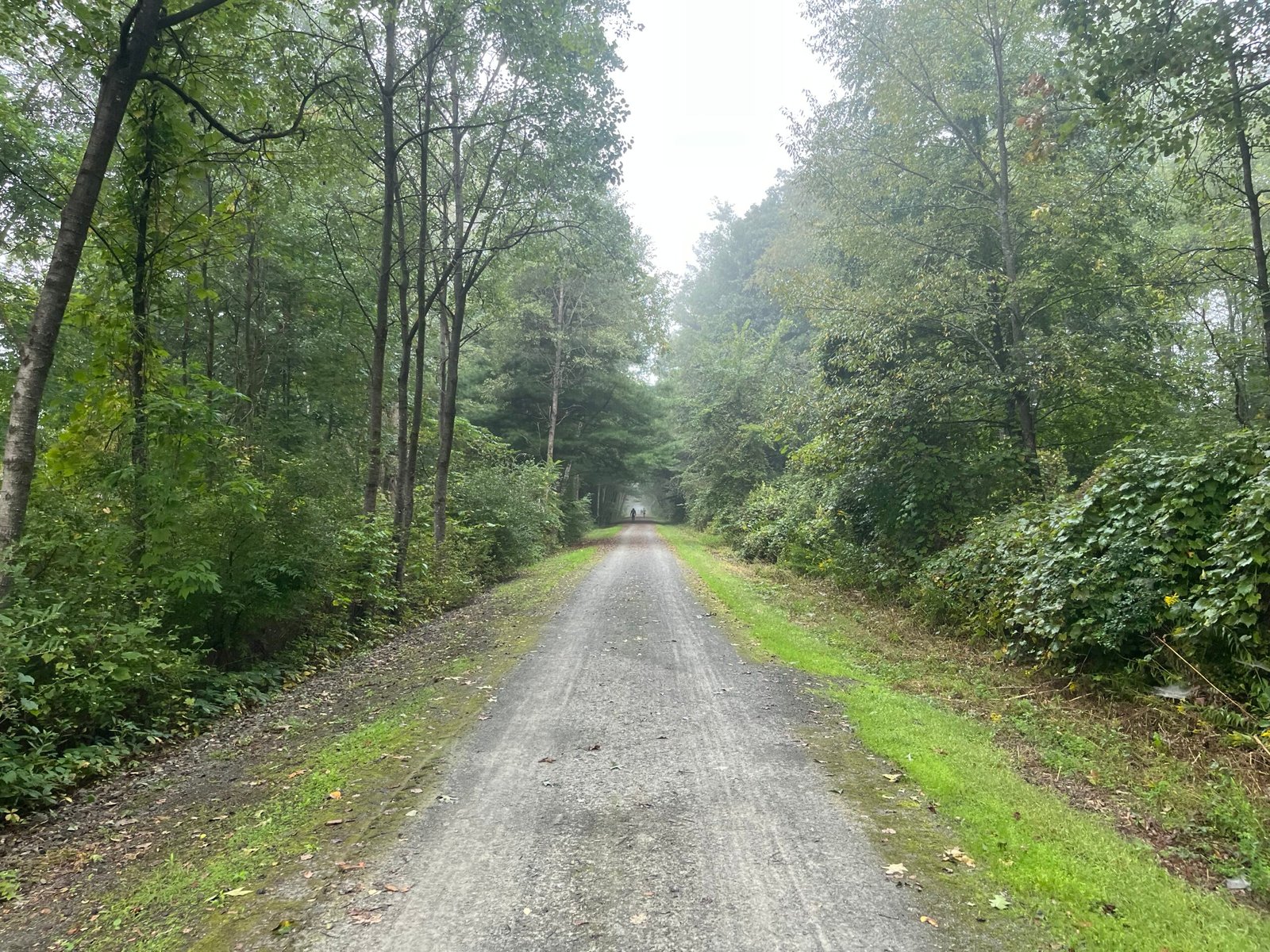 Nothing to trip over, fall into, or stop to look at here in the green tunnel.
In this first section, the area never remained static. For anyone who has spent a lot of time on the C&O Canal towpath, you know what I’m talking about. At Pine Creek, for every green tunnel section, we also found ourselves running through what amounted to open pasture, or past a group of rural houses, or right beside corn and soybean fields. The landscape never got boring, and there was always something to draw your attention away from the flat path in front of you.
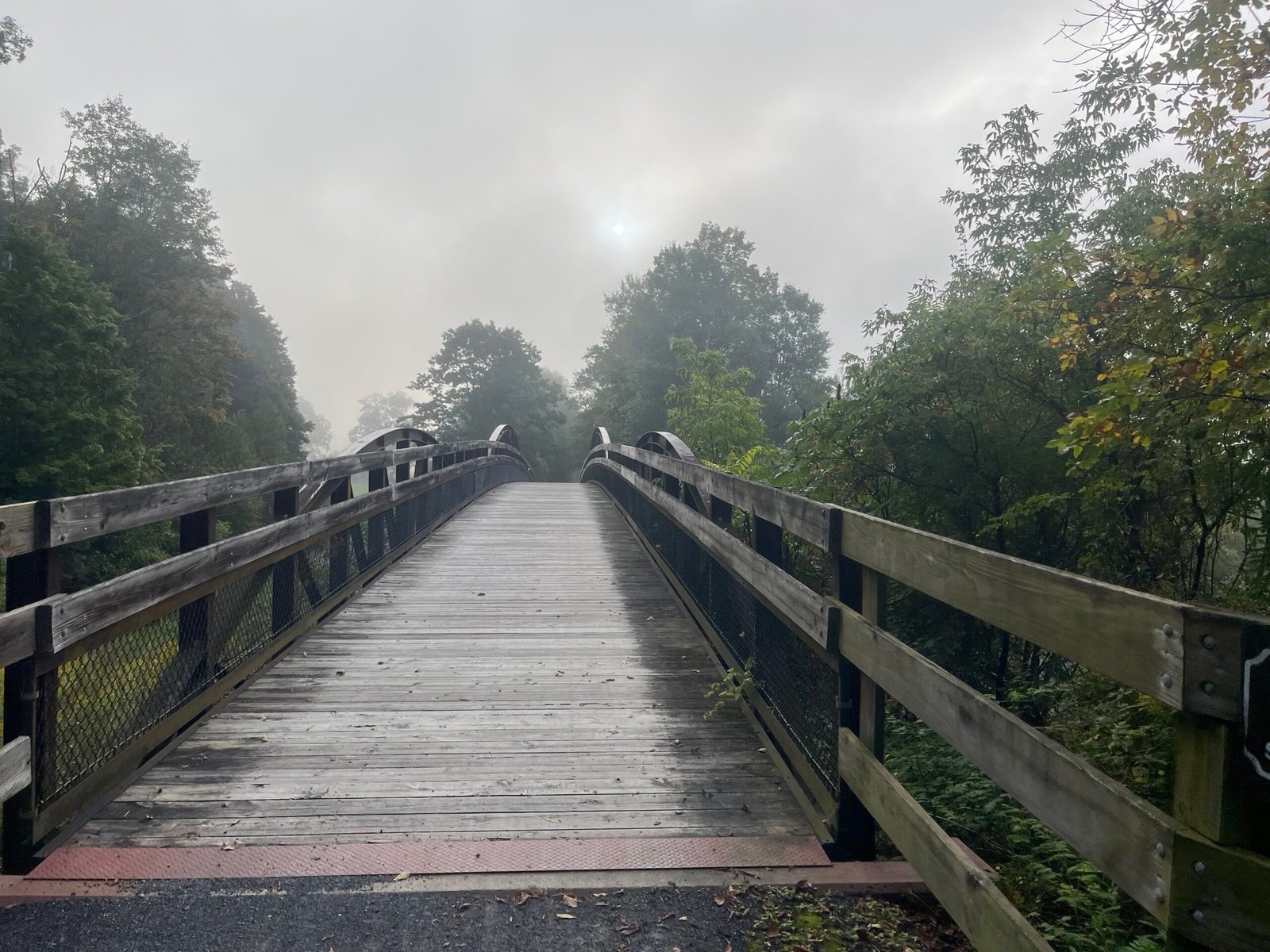 One of many bridge crossings we would encounter throughout the course.
I never like to think too far ahead during 100-mile events, though it’s inevitable, but it was around the end of the first section, as we approached the start/finish, that I began to wonder how I planned to keep things up. This wasn’t to say what we were doing (9:3 run/walk with an avg. pace of 11 or so minutes per mile) didn’t feel fine in the moment, but what about mile-40? 50? 60? I didn’t want to go out too fast, dig myself into a hole, and end up unable to crawl out again.
But such thoughts would have to wait . . . at least for a little while, because it was about that time when we finished the first leg in 2 hours and 50ish minutes.
Marsh Creek to Blackwell and Back (15.2 miles to 50.4 miles)
I grabbed a new nutrition bag (which had my gels, bars, chews, powders, and so forth sealed up inside) from my start/finish line drop bag, beelined to the bathroom, and then took off in pursuit of Casey and Grayson. Pursuit is, of course, a generous term for what it actually was: a slow jog to catch back up to them again. Once our group was re-established, we returned to our 9:3 run/walk and settled in for the 17-plus mile ‘outbound leg’ to Blackwell.
The early miles always go quicker when the vibes are good. Casey and Grayson were excellent company, but so were the other runners out on the course. Since the race staggers the various starting fields (the 100-mile runners start first at 0600, while the marathon runners start at 0900 with the 100k and 50-mile runners sandwiched in between), you ended up getting passed by a lot of people throughout the day. Quick words of encouragement back and forth can go a long way when the going gets tough, which is why I tried to be as supportive as possible to those around me, even when it got a bit ridiculous during the craziness of the overnight.
On the leg to Blackwell and back, you leave behind the rural countryside of the race’s first section, and enter right into the Pennsylvania Grand Canyon.
Grand Canyon?
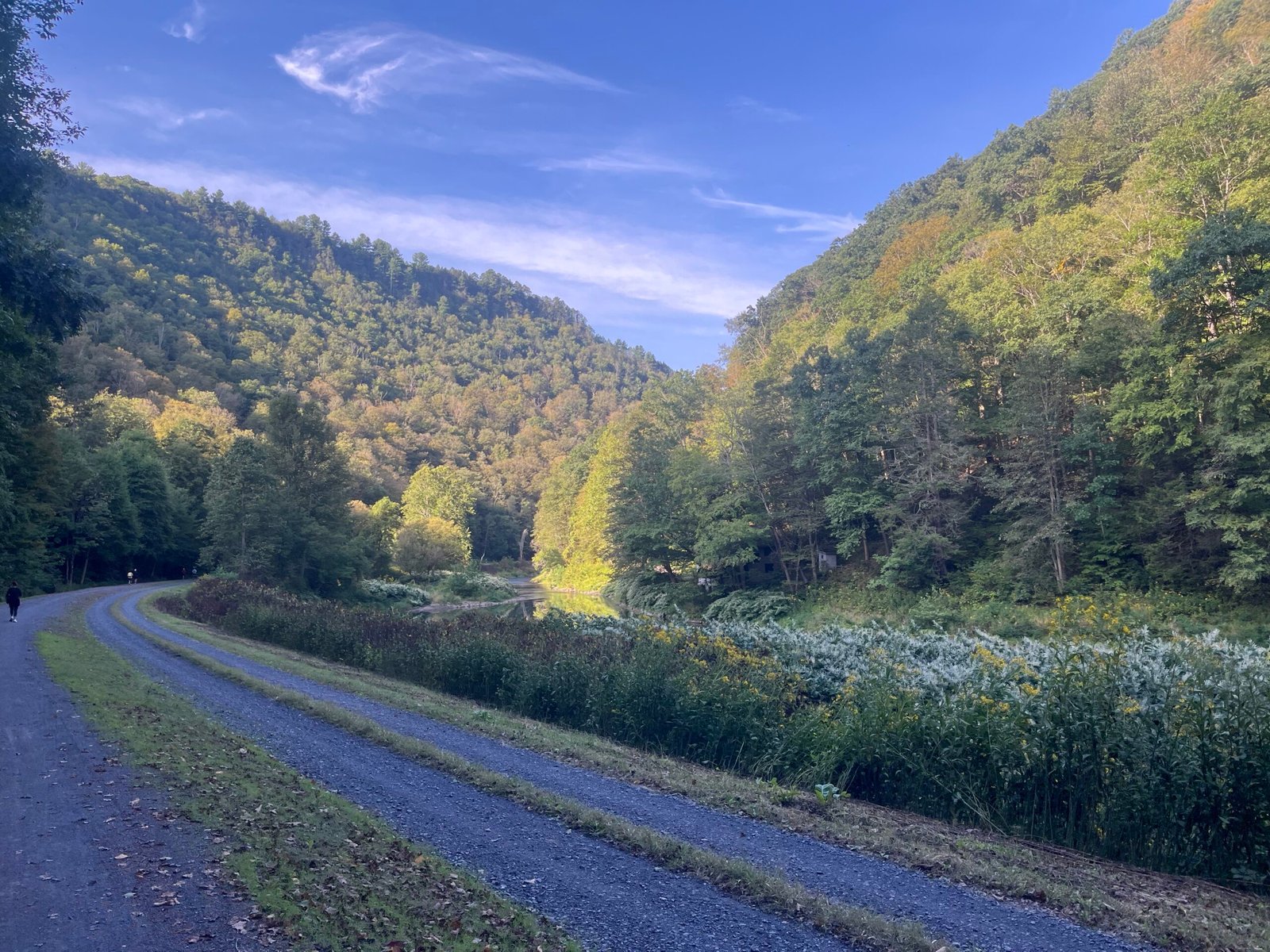 Yeah, the Pennsylvania Grand freakin’ Canyon.
This section of the course was just plain cool. Knowing next to nothing about the area, I didn’t appreciate how grand it ended up being, nor how unique the miles from Marsh Creek to Blackwell turned out to be. Races like Pine Creek are a good reminder that we don’t always have to go into the mountains to find great views/landscapes/and so forth. Sometimes even a flat path can inspire wonder.
The beautiful landscape stood in perfect contrast to my deteriorating mental state as the dreaded 100-mile crash began to take shape. I’m not sure exactly when I started to lose my edge, but by the time I reached the turnaround at Blackwell–some 32ish miles in–I was ready to let Casey and Grayson go on ahead while I abandoned the 9:3 run/walk in favor of something with a bit (okay, a lot) more walking. You never want to start doing math, which is what I did, and I started to think about 27 . . . 28 . . . 29-hour finish times. Could I at least match my C&O time from 2024? Maybe. In any case, the thought of walking for another 68 miles seemed impossible.
Of course, I didn’t end up walking for 68 miles. One of the most important lessons I’ve learned throughout my “ultra career” is to never trust the moment. The highs and lows ebb and flow, like the ocean tide. At Blackwell, instead of spiraling into a complete meltdown, I went through the aid station plan I had formulated over the miles before we arrived, making sure to take an extra cup of Coke with me before leaving on the trip back to Marsh Creek. I had decided to stick with Casey and Grayson until at least the start/finish, where I could then reassess whether or not I needed to slow down.
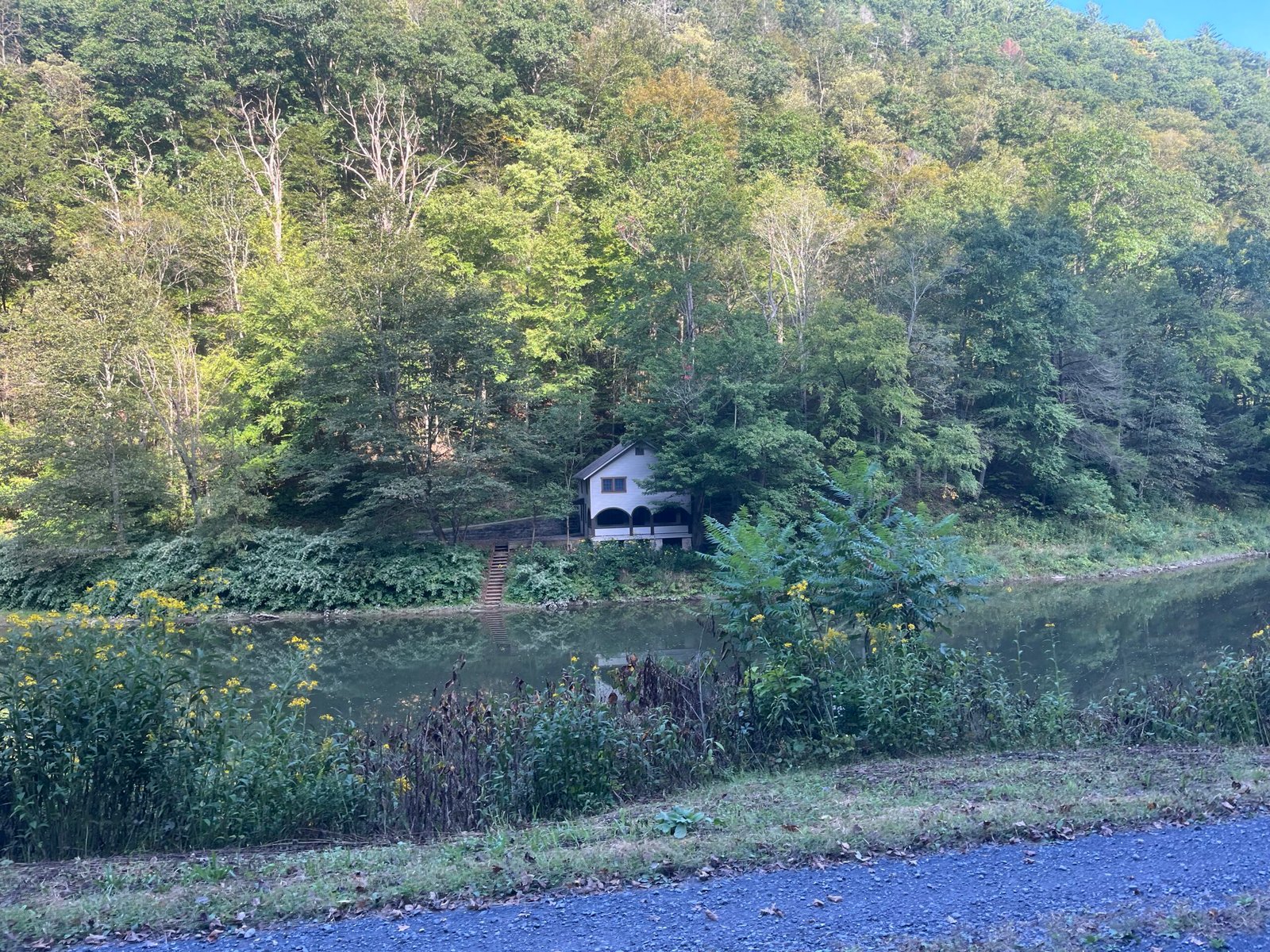 One of the many houses lining the opposite side of the creek.
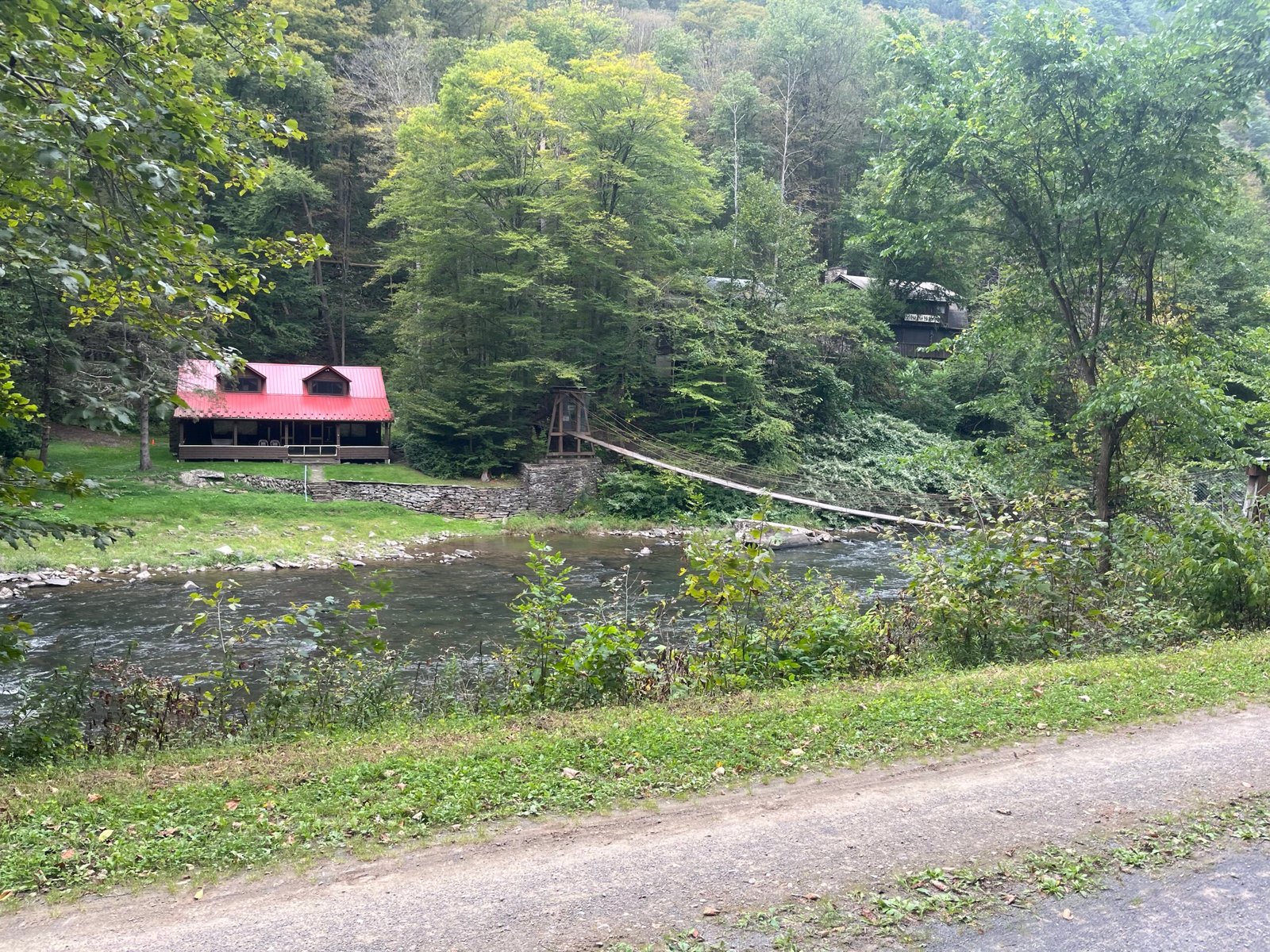 This one even had a bridge going from one side to the other.
As we set off on our return trip to Marsh Creek, I settled in for what I thought would be a long, long 17ish mile stretch. I have been in this position before, where the wheels fall off, and I know it well, so I waited for the ultimate crash that would reduce . . . me to a . . . slow . . . .
And I waited . . . .
And waited . . . .
And–wait, did I feel better?
Yes, yes, I did.
Turns out, I was being a bit dramatic. No, the wheels weren’t falling off–yet. But being so low in the low-30s was still concerning. I didn’t want this race to turn into a death march before I even reached the halfway point, as some of my 100s in the past had. So I made sure to stick with my nutrition plan, while also supplementing with the odd item here or there from the aid station, as well as soda.
As we drew closer to Marsh Creek, I began to feel better and better. The prospect of being done with the first loop, halfway there, at close to 10 hours was a great feeling. It’s hard to explain the highs and lows of a race unless you’ve run one before, but it’s one of the parts I love/hate the most about running ultramarathons. Going from ‘I want to walk the race at mile 30’ to feeling like I could run every single step the rest of the way at mile 46 was remarkable.
It was during the return trip that we encountered horses for the first and only time during the event. One of the hallmarks of the Blackwell out and back was the ‘second lane’ on the path designated for horses. Until our return trip, the only ones using the second lane were fellow runners and the people riding their “bikes.” (If you know, you know.)
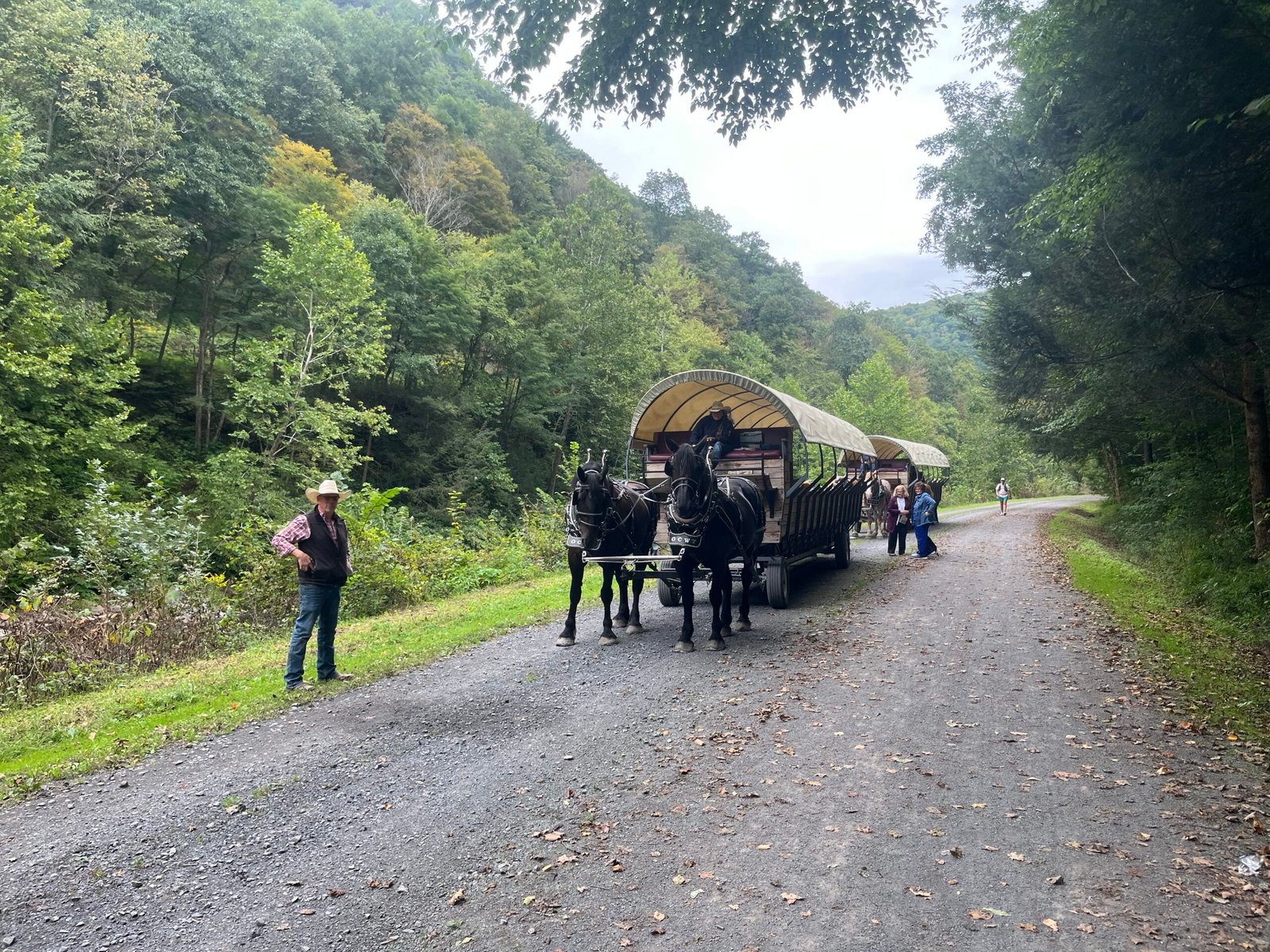 Ye’ Old Covered Wagon Tours in action
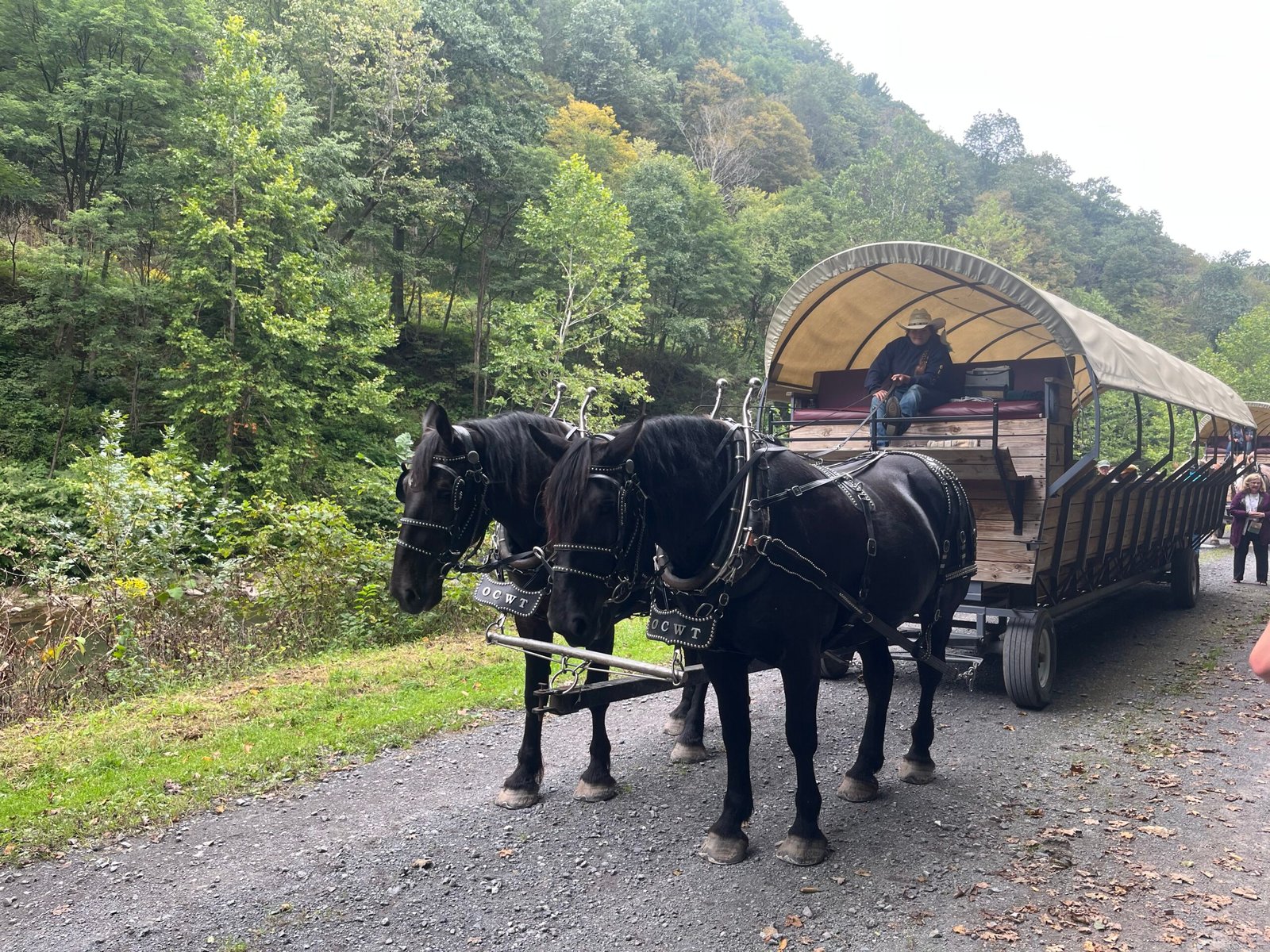 First Set
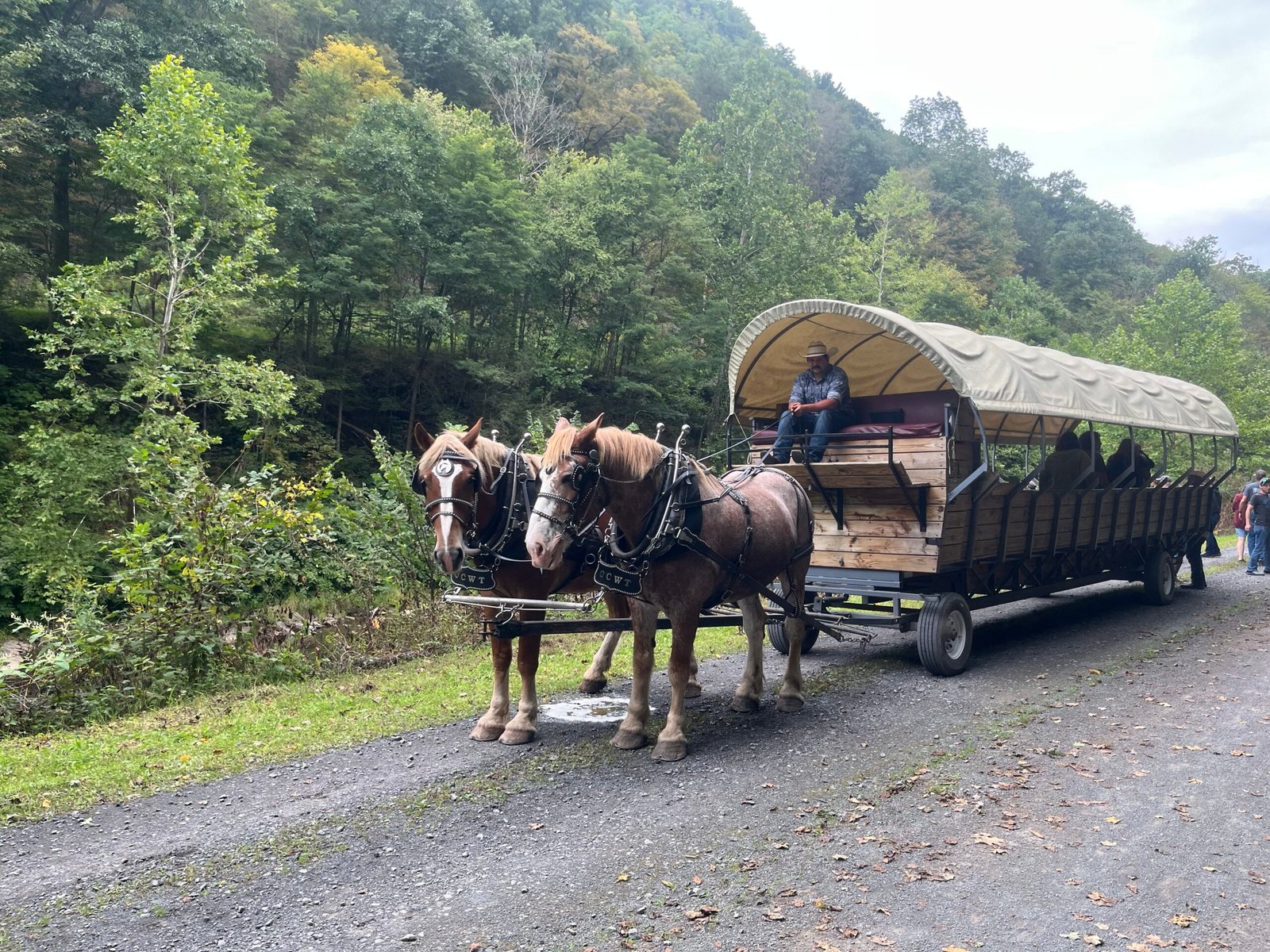 Second Set
After going through Darling Run, we arrived back at the start/finish in 10:xx hours. The first loop was over; now it was time for the true fun to begin.
The start to Wellsboro Junction and back (50.4 to 65.6 miles)
I haven’t talked much about my two running companions, Casey and Grayson, mostly because both seemed to be holding up well to this point. Even when you run with other people during an ultra, you end up in your own little world where no one except you can venture into. It’s hard, unless someone says something, to know what they’re feeling inside. So as we quickly went through our drop bags and prepared to venture out, I had no idea how close to the end our group was to extinction.
We left Marsh Creek sometime after 1600 and headed out on the final trip to Wellsboro Junction. During this section, we were joined by Casey’s daughter, who jumped in to pace the 15-mile section. She was a welcome fountain of energy for a group of weary ultrarunners whose main concern was when the rain would start.
Rain?
Okay, yeah. Well, I haven’t mentioned the weather yet, have I? For the first 10 or 11 hours, it wasn’t particularly noteworthy. The temps remained manageable, though it did feel a bit humid. I thought the weather was great, but it wasn’t too long after we left Marsh Creek that it would change . . . for the worse.
But before the rain, we lost the first. Grayson the younger, the 100-mile newbie, had developed, over the course of a couple of hours, debilitating foot pain that led him from sticking with the 9:3 for nearly 60 miles to being forced to walk the remaining couple of miles back to the start/finish to drop. The splitting of the group actually happened after we left Wellsboro Junction, when Casey and I wished him well before taking off together, along with his daughter, on a newly minted 9:3 walk/run strategy (the inverse of what we had been doing for the first 60 miles).
(I should note that this ended up being Grayson’s longest effort ever, nearly double his previous best (32–65). Maybe the jump from 32 miles to 100 was too much? I also dropped my first 100-mile attempt at C&O, so maybe it’s just part of the learning experience to fail the first time you attempt the distance. Failure is the best teacher, after all. I know he’ll be back.)
The trip from Wellsboro back to Marsh Creek brought us into the nighttime. It also brought out the beginnings of the rain. (Oh, the rain!!) But before the rain started in earnest, we covered the 15-mile section in a hair under 4 hours, which brought us back to the start/finish line at mile 65-ish in a little over 14 hours. Not bad, eh? Any thoughts of not finishing were well and truly banished at this point, as the final section rested between us and the end.
Marsh Creek to Blackwell and Back (65.6 miles to 101 miles)
This aid stop ended up being the longest of the event. I changed my shirt into a long-sleeve, put on my rain jacket, grabbed my gloves, headlamp, waistlamp, a new buff, changed my shoes and socks, and opened a new nutrition bag. I ended up deciding to change my shoes and socks because the shoes I had been wearing up to that point–Topo Ultraventure 5–had started to rub against my Achilles. This ended up being a good move, because I turned what would’ve been a major problem/pain over the last 35 miles into a manageable issue that didn’t result in me losing any time. I’m also glad I brought the long sleeve/rain jacket combo, though in retrospect, I should’ve brought an even more robust jacket to deal with what would soon rain down upon us.
When it rains, it pours.
Case in point, it wasn’t long after leaving Marsh Creek that our duo became two solo missions. I think it was around mile 67 or so, but Casey and I split up, as I pushed ahead and he slowed down to manage a wonky stomach. In the past, I probably would’ve slowed down and stayed with him, but as I’ve “progressed” over the years, I’ve learned when it’s good to seize the initiative and continue to push even if it will result in the end of a long-established group dynamic. Sometimes people need space, sometimes I need space, and sometimes it’s good to change things up. This usually only holds in 100-mile efforts, though, because in shorter events, if I’m running with someone, I generally like to remain with them until the end.
After our split, I continued alone on the march to Blackwell. It was around this point, mile 70 or so, when the rain began coming down in earnest; at certain points, it was raining so hard that I couldn’t see more than a couple of feet in front of me. (I’m glad I had my waist lamp with me because the Fenix headlamp I was wearing was worthless in the downpour.) I also started to run again after walking for the hour or so since leaving Marsh Creek. My legs felt great, and I knocked out five consecutive 12-minute miles. There’s something about running in the rain that never gets old, no matter how much you’ve done it (at least for a while), and this remained true during the 5-mile stretch I ran into aid station two at Tiaghdaton.
Of course, the good times weren’t meant to last, and it wasn’t long after leaving Tiaghdaton that the running would come to an end for the rest of the event. Part of the problem was that I had started sweating inside my rain jacket, which, when added to the downpour, left me very cold (I had to stop sweating so much). I also realized that I was able to average right at a 15:00 minute avg. pace just walking, which was good enough–if I could keep it up–to get me to the finish line under 24 hours. The final problem was nutrition. The first two points aside, if the nutrition had remained consistent, I most likely would’ve been able to run even more than I did later into the race, but my nutrition plan fell apart at some point in the late 70s, leaving me at a manageable level for the rest of the miles as long as I didn’t push the pace too hard. Taken together, after Tiaghdaton, walking to Blackwell and then back to the start/finish seemed like the right choice. Part of the 100-mile “game” is making adjustments on the fly, knowing when to push and when to back off, and how to manage what you can control. Thankfully, I do have some experience.
Everything was soaked as I entered the Blackwell aid station . . . and walked past it. Did I mention that the Blackwell turnaround isn’t right there at the aid station? No? Well, it’s not. You actually have to go another half mile, round a cone, and then head back. Not so bad on the first out-and-back, but now? When I was tired, soaking wet, and cold? Yeah, you bet.
I knew that staying at Blackwell for any length of time would be a bad idea. The aid station was great, but the heater they had running underneath the runner’s canopy might as well have had DNF written across its metal. So I got in and out as quickly as I could, and started the long 17ish-mile march back to the finish line.
I passed Casey a mile or two outside the aid station, and was glad to see him continuing to plug away at things. I wasn’t much in the mood for talking, so a quick nice job was all that passed between us as we each faded into the bubble world of our respective lights. (He would finish in 25:xx.) I had actually managed to pass a couple of people on the outbound trip from Marsh Creek, but I don’t think I passed anyone else on the return trip–at least, none I could see.
The interminable nighttime sections of 100-mile races always blend for me. Periods of quiet were interrupted by spells of rain, but it never poured again as it had earlier. I even managed to dry out just enough to keep the cold from becoming uncomfortable. I don’t have many other details to share, because most of it is going from point A to B with little notice being paid to the world around you. The fun from the early miles is long gone, and now it’s about the grind. Mile after mile, hour after hour, and before you know it, six or eight hours have gone by, and instead of being at mile 71, you’re at mile 99.
Then 100.
Then–
Marsh Creek (Finish)
Then it was over, 23:38:xx or thereabouts, I believe. I finished to the applause of, well, a couple of people, haha. (It was 5-something in the morning, though, so what can you expect?) I was just glad that it was over. After collecting my buckle and handmade finisher’s mug, I collapsed into the nearest chair and lounged for the next 15 minutes, like a spent barncat after a particularly intense chase with a field mouse. The chair felt good, but the relief I experienced felt even better. I had finished. No DNF. No bad excuses. The streak had been broken.
I was out of the red and into the black.
Aftermath
I didn’t spend much time at the finish line because I wanted to get out of my wet clothes as fast as possible. It had stopped raining at this point, but knowing it could start again was enough to push me forward. I walked slowly back to my campsite, got myself sorted out, and then climbed into the back of the car to catch some much-needed sleep. A few hours later, I was back on the road home.
The biggest compliment I can give a race is that, after finishing, I understand why it exists. Pine Creek has a solid identity, great volunteers, and a beautiful location. It’s a race I’m glad I did.
As for how it went, I have no complaints. I finished. The goal was achieved. The sub-24-hour time was icing on the cake. Could it have gone better? Sure. But sometimes good enough is good enough. Time isn’t always the most important thing with these races. The achievement itself is often satisfaction enough on its own.
On to the next.