First things first, let’s establish the most important fact.
Yes, the Ring is hard. Hard with a capital H.
THE WHAT
No, I’m not yelling at you.
On Saturday, September 5th, I will return for the umpteenth time to the Massanutten Mountains, this time for my third annual battle against the Ring. The Ring, per the Virginia Happy Trails Running Club web page, is as follows,
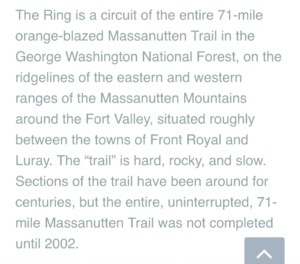
Course description, per the VHTRC Webpage
and each year since 2002, the VHTRC has hosted this now-infamous challenge for all those brave enough to take it on.
Beyond the sheer difficulty of the Orange Trail, with its endless miles of ridgeline, 13,000-plus feet of vertical gain, rocks, green tunnel, rocks (did I mention rocks?), is the simple fact that the Ring is entirely self-motivated. There’s no entrance fee, no real leaderboards (though the participants’ time and place are accounted for to legitimize later bragging rights), no significant finisher awards, no course markings except for the orange blazes on the trees (the Ring’s mantra: “stay on orange” is where this blog gets its name), and the aid stations are, for the most part, spread out. In fact, over the first 25 miles of the Ring, which includes the climb out of Elizabeth Furnace (fun fact: this is where the aid station is located at mile 33 of MMT) and the first ridgeline, the only aid is a water drop around mile ~13 at Mildford Gap. Volunteers hike this aid up the mountain to the ridge, so gratitude is an understatement, but since the event takes place on Labor Day weekend, you can imagine how difficult this 25 miles of hot, humid trail is right from the start. I’m sure the wonderful volunteers share a laugh or two at the sad state of the runners coming into Camp Roosevelt, the first proper aid stop at mile 25. Of course, it doesn’t help that right after Roosevelt, runners set off up Duncan Hollow, of both MMT 100 and Old Dominion 100 fame, before stumbling down the trail for some miles and reaching Waterfall. Then you have Kerns, Short Mountain, the climb out of Edinburg, and the long, dark march to Woodstock Tower. Add in a punchy climb up to Signal Knob from Powell’s Fort at the 100k mark, and the endless, agonizing descent from Signal Knob to the start/finish line, and you can begin to understand how the Ring acquired its reputation.
As for me, I have 1 finish (2025) and 1 DNF (2024).
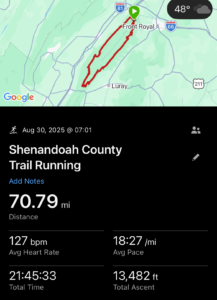
2025 Finish
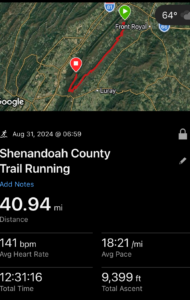
2024 DNF
I also have two DNS’s (did not start) as well (2022, 23), which came from me lacking the motivation (courage?) to tackle such a difficult challenge.
THE WHY
Now, you may be wondering why on earth, after finishing last year, I’m deciding to put myself through this ordeal again. Most people lucky enough to finish the Ring are ‘one-and-done.’ In fact, when the event first started, they had a ‘one-and-done’ rule to encourage runners to come out again and volunteer (something I plan to do next year).
Well, part of the problem is that I am an ultrarunner, and, like all ultrarunners, I have a horrible memory. We always say “never again,” but I’m hard-pressed to think of a time I actually meant it. A month or two will pass, the memories will grow dull, and you’ll begin to think back fondly on what was a pretty miserable time. “It wasn’t that bad, was it?” You ask, months later, as you stare at your reflection in the computer screen. And then one thing leads to another, and before you know it….
Another reason is that I’m curious to “test myself” again (was last year a fluke?) and see if I can improve on last year’s effort. I should add that last year, I ran with a friend, Randy, whom I also DNF’d with the year before, but this year will be all me. Solo. Can I break 20 hours? 18? (Probably not).
The final reason, and a damn good one, is that the VHTRC puts on some of the best events on the East Coast. Forget that this is a fat-ass race, because I can promise you that you’ll walk away from the Ring-or any of their other events-with the impression that you just ran a premium ultramarathon. The aid stations, which are both runner-supported (through mutual aid we’re assigned to bring) and group-supported (purchased through the use of group funds paid for by our 15-dollar per year membership fee), lack for nothing. And we can’t forget about the volunteers, who go above and beyond to support everyone who shows up to run. The VHTRC embodies the old-school attitude towards ultrarunning I believe in (more on that in another post), while respecting the legacy of community-oriented, not-for-profit events. The Ring might not have a finish chute or livestream, but it does have everything you want and need to succeed at one of the toughest ultra challenges on the East Coast.
THE HOW
We have what, we have why, and now we need how. How do I plan to make it through 71 miles of Orange-blazed Massanutten Trail this weekend? What will I wear? What will I eat? Where will I…well, let’s not think about that.
I’m unapologetically simple in how I approach most events. I don’t use spreadsheets; I don’t look at splits; I don’t consult star charts to see if my astrological sign will be in alignment. I’ve found, through trial and error, that complexity is the enemy of good enough. The reality is, I’m not running events to win them. For me, it’s not about Kudos, prospective sponsorships, or course records. At this point, I know what I need, and what works and what doesn’t. (Though I’m always learning new stuff.) Is it the fanciest? No, not at all. The trendiest? Hardly. But that’s how it is. If it’s not broke, don’t break it on purpose.
Okay, on to the nuts and bolts.
With nutrition, I will fuel with a combination of gels, bars, chews, and Tailwind. After a while, I know the gels, bars, and chews will become more trouble than they’re worth, at which point I will switch over to whatever looks good at the aid stations. Tailwind usually works well for me, but palate fatigue is real, and even with two flavors, I’m bound to get sick of it at some point. Soda will become my friend then, as will whatever liquid sounds good in the moment. I will aim for 150-200 calories per hour, but who honestly knows what the real number will end up being. I don’t bother worrying about carbs per hour or anything like that, because such precision (ha-ha) doesn’t interest me. If forcing myself to hit certain numbers is taking away from my experience on the course, then I’m not going to bother. Like I said, good enough is good enough. As for gear, a picture is worth a thousand words.
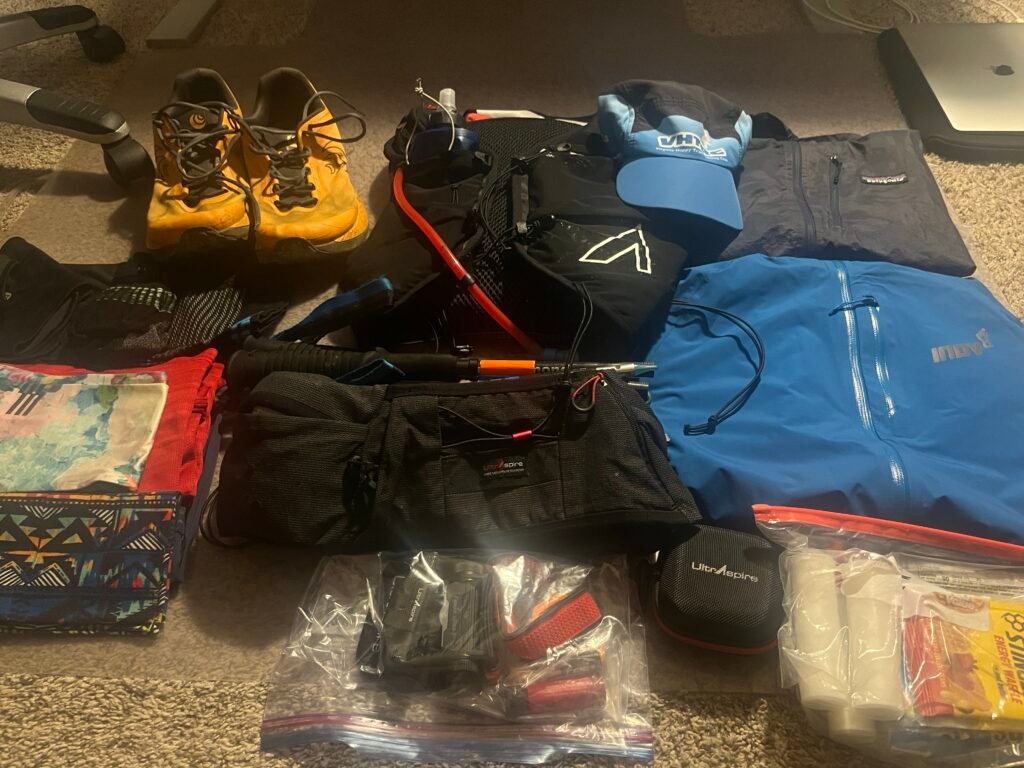
Sorted gear for the Ring, waiting for September 5th
Most of the gear I’m taking with me, except for a few odds and ends, will be used. I don’t mind packing extra. As the saying goes: I would rather have and not need than need and not have. With how volatile and dynamic conditions can be in the mountains, I think overlooking something like an extra water flask or spare headlamp is foolish. At the end of the day, we’re ultimately responsible for our own safety out there. If having extra means I make it back in one piece, then that’s what I’ll do.
Now, before moving on, I want to touch on the three pieces of gear I feel are the most important for the Ring.
A GPX file might not seem like “gear,” but having it loaded on your watch and phone, as well as having some general course knowledge, is essential. You won’t finish if you don’t know where you’re going. “Stay on orange” sounds simple until you find yourself on pink, white, or blue. Paper maps and a turn sheet aren’t bad to have either. The only markings at the Ring are the blazes, so knowing how to navigate them is crucial.
Second, and most important, are light sources. Yes, light sources. Two. For me, this means wearing a headlamp (while always carrying a backup headlamp with extra batteries for both, just in case) and using a waist light. For headlamps, I use Fenix, and the model I’ll be using at the Ring is the HM62-T. This light is as simple as simple can be. One button turns the light on and cycles through its various modes, and that’s it. It takes 18650 batteries, which are the same batteries used in my Ultraspire waist light, meaning I don’t have to worry about managing which battery goes into which light (you’d be surprised how difficult messing with lights can be overnight when you’re tired). The waist light I’ll be using is an older Ultraspire Lumen 800 (if it works, run it). This will attach to the ‘lumen bracket,’ which slots into the Ultraspire Mountain Racer waist belt. I never run the waist light on full brightness, so I usually only end up going through 1 battery during a full night (though I hope to not be out there for a full night at the Ring). The combination of the waist light (to see the ground) and the headlamp (to see where I’m going) has never let me down. And at the Ring, where you will be alone overnight and it will be dark, having adequate light is crucial to getting through the course and navigating the rocks. The last thing you want is to be halfway between Woodstock and Powell’s Fort and lose your light source.
The final piece of gear I think is crucial for success at the Ring is a good hydration setup. Let’s face it, it’s going to be hot this weekend (the high on Saturday will be 81 degrees farenheight). Even after the first 25-mile section, where you have one water-only aid stop at mile 13, the distances between aid stations range from 5.5 to 9.5 miles. In an ultra, especially later on, we’re talking about hours and hours. Being able to carry enough water, food, and gear to get you from section to section isn’t just a smart strategy, but it’s also an essential safety step. You don’t want to end up halfway through a section only to get caught in a thunderstorm without a rain jacket, or run out of water at the bottom of a long climb, or end up with a broken water bottle cap with no backup. As for me, I’ll be using the Ultraspire Legacy 3.0. This pack will allow me to carry a water bladder, something I don’t use often, but which, for the Ring, I think makes sense. I will also use the Ultraspire Mountain Racer waist belt to spread out the weight and, for the night section, to carry my waist light.
Beyond that, everything is fairly standard. Over the years, I’ve found that there’s no secret to getting your gear right. You have to go through trial and error to get the optimal combination, and eventually you’ll dial it in. Of course, for the Ring, I wouldn’t recommend doing too much trial and error. Save that for another time.
FINAL THOUGHTS
The starting list right now has 42 entrants currently listed. I imagine close to 40 will start, and sometime before the 28-hour overall cutoff, most will finish. The Ring is not a beginner-level event. To apply and be accepted, you have to show some level of “ultra competence” at either other Massanutten events (MMT100, MMT training runs, other FA races, etc.) or a 100-mile finish. The particular challenges that come along with this run make it a force to be reckoned with. But that’s why we do these things, isn’t it? If it were easy, everyone would be out there. No, I prefer things this way, and I’m sure most of my fellow runners do as well. The challenge is what makes it fun.
(Okay, let’s hope I can remember that tomorrow, around mile 36 or so, when I’m trudging over Kerns and wondering what the hell I was thinking.)
Until then, Happy Trails!!
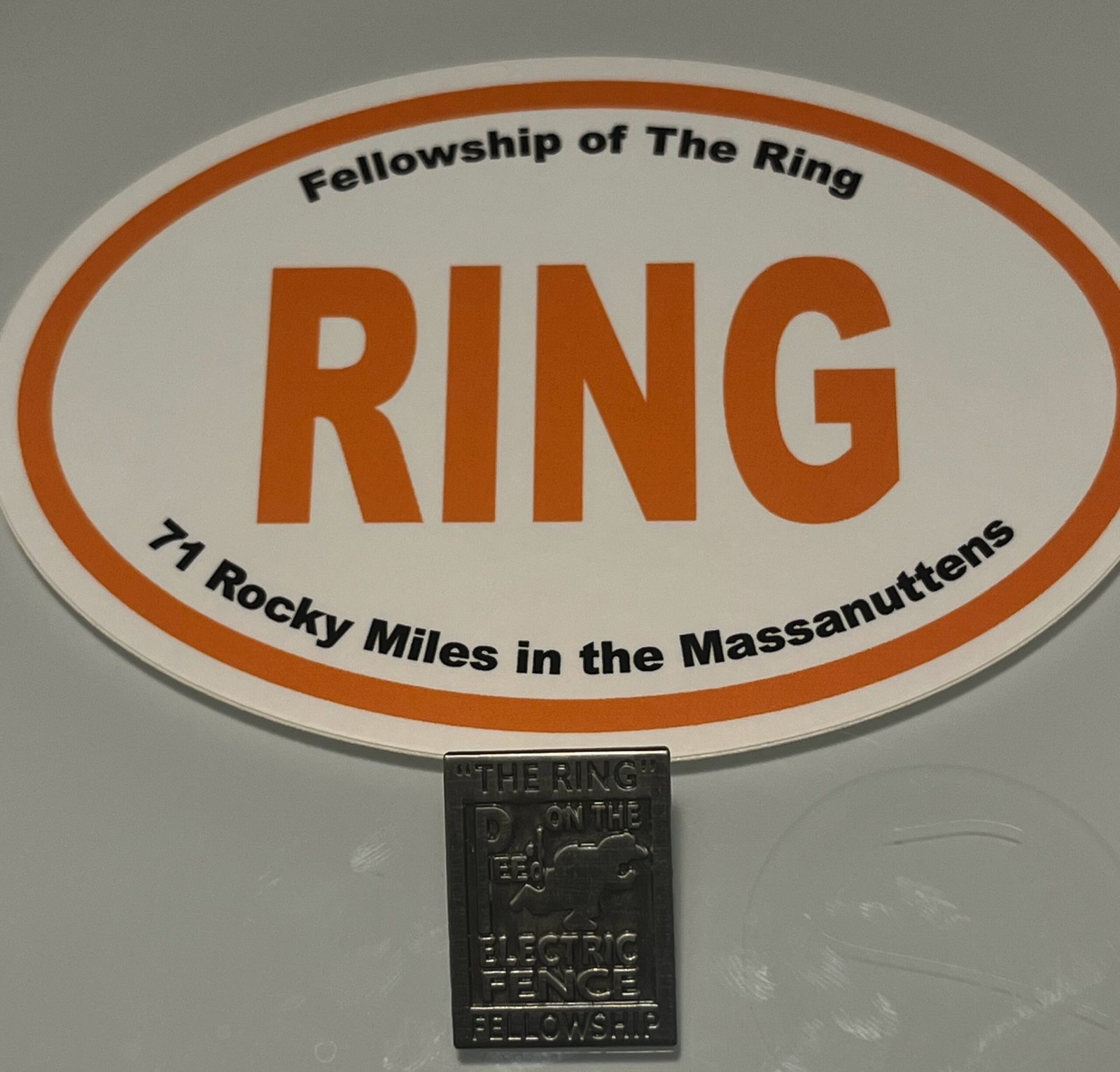
What you’re fighting for (except the sticker, which now has a different design).
P.S. If you ever want to run the “Reverse Ring” in February, which is, you guessed it, the Ring in Reverse (counterclockwise instead of clockwise), then you first need to finish the Ring and become a member of the Fellowship. I haven’t tackled the Reverse Ring yet, though 2027 looks promising… Hmm…. Ask me in a month or two.
P.S., P.S. This is my first-ever “race preview,” so I probably spent more time on it than I should have. Oh well.